
U.S. Sanctions Canadian Financial Firms Accused of Helping Iran
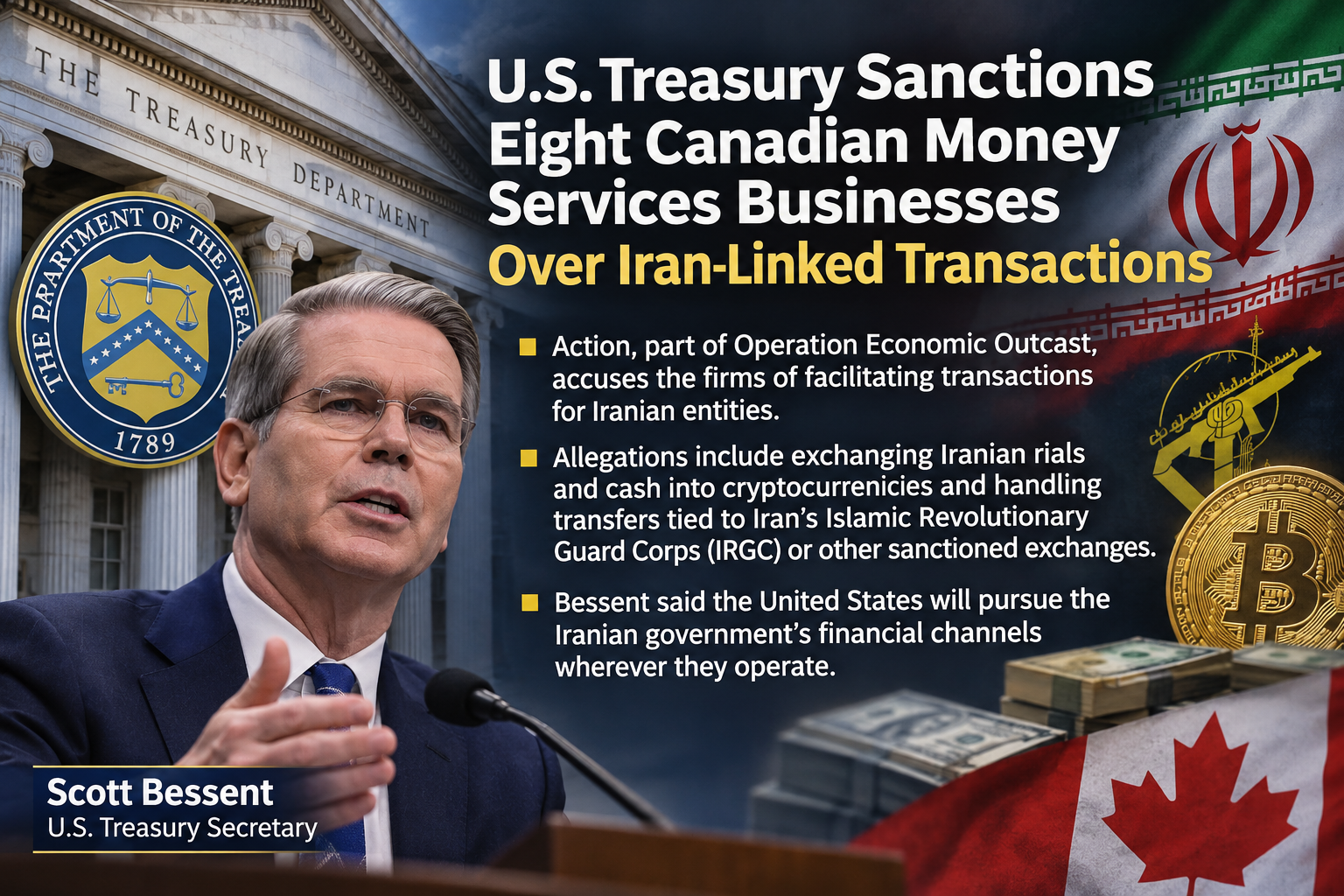
The U.S. Treasury Department sanctioned eight Canadian money services businesses it accused of facilitating transactions for Iranian entities and, in some cases, laundering proceeds for drug traffickers.
The action, part of Operation Economic Outcast, targeted companies alleged to have exchanged Iranian rials and cash into cryptocurrencies and handled transfers involving digital addresses associated with Iran’s Islamic Revolutionary Guard Corps or sanctioned exchanges. Treasury Secretary Scott Bessent said the United States would pursue the Iranian government’s financial channels wherever they operated.
The eight sanctioned entities include Million Exchange, two firms doing business as Amin Exchange, NIA Nations Currency, Farah Exchange, CCC Inc., B Galaxy Inc. and Darvish Exchange. Treasury said their services permitted transactions between Iranian rials and digital assets outside traditional banking channels.
Treasury Secretary Scott Bessent said Canada could not become a safe haven for entities facilitating sanctions evasion for Iran and its proxies. He pledged to pursue the country’s financial channels regardless of where they operated.
The action was taken through Operation Economic Outcast, which the Treasury Department launched in August. The program targets financial networks connected with Iran’s Islamic Revolutionary Guard Corps and other sanctioned actors, including their use of cryptocurrency.
According to the Treasury Department, digital asset addresses linked to Million Exchange sent hundreds of thousands of dollars to addresses associated with the IRGC or terrorism-related activities. Investigators also accused the company of converting drug-sale cash into cryptocurrency for traffickers.
Amin Exchange, operating through entities registered in British Columbia and Ontario, allegedly handled millions of dollars in Canadian drug proceeds. Treasury said it had processed cash associated with former Olympic snowboarder Ryan Wedding, who was apprehended in January 2026 after an international trafficking investigation.
Farah Exchange allegedly conducted transactions with sanctioned Iranian exchanges and sent millions of dollars in digital assets to addresses connected with Wedding. Other targeted businesses allegedly transacted with exchanges such as Nobitex, Wallex, Bitpin, Ramzinex and Shelbit.
The sanctions were coordinated with the Financial Crimes Enforcement Network, Canada’s FINTRAC financial intelligence unit and the Drug Enforcement Administration. Officials emphasized links between sanctions evasion and the laundering of proceeds from organized crime.
Under the designations, property subject to U.S. jurisdiction belonging to the entities is blocked and transactions with U.S. persons are generally prohibited. Entities at least 50% owned by blocked persons also face restrictions, and violations can result in civil or criminal penalties.
Treasury said the measures build on earlier sanctions imposed in June and August against Iranian cryptocurrency exchanges accused of moving money for sanctioned entities. Officials said investigations into the international movement of illicit digital assets would continue.
Treasury identified Million Exchange, two businesses operating as Amin Exchange, NIA Nations, Farah Exchange, CCC Inc., B Galaxy Inc. and Darvish Exchange. Several were alleged to have processed assets for former Olympic snowboarder Ryan Wedding, whom authorities linked to drug trafficking. The sanctions block property under U.S. jurisdiction and generally prohibit transactions involving designated entities.
Related Stories:
-
 California Man Pleads Guilty to Attempting to Support ISIS
-
 Trump Names Stephen Miller White House Chief of Staff
-
 Michigan Attorney General Race Tightens as Republicans Target Democratic-Held Seat
-
 Trump Administration Announces Fraud Crackdown in Minnesota
-
 Ilhan Omar defiant after reelection amid federal scrutiny
-
Chinese Nationals Sentenced for Secret Intelligence Operations