North Dakota Property Tax Relief Expands to 50,000 Households
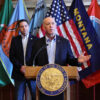
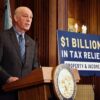
As property tax statements arrive in North Dakota mailboxes this month, Gov. Kelly Armstrong joined lawmakers and State Tax Commissioner Brian Kroshus at the Capitol Friday to spotlight the expanded property tax relief provided by the $1,600 Primary Residence Credit (PRC). The credit, approved last spring, has eliminated property taxes for roughly 50,000 households — double the number initially projected — and lawmakers are already discussing ways to expand it further.
The PRC, boosted from $500 to $1,600 through House Bill 1176, introduced by Rep. Mike Nathe (R-Bismarck), was initially estimated to eliminate property taxes for 25% of eligible households. Recent data from the Tax Commissioner’s Office shows the higher credit has wiped out taxes for 30% of eligible homeowners, roughly 50,000 households, compared with just 16,000 households, or 10%, under the previous $500 credit in 2024. Armstrong noted that 50,000 households is roughly equivalent to the population of Bismarck.
An additional 95,000 households will pay reduced property tax bills after the $1,600 credit is applied. A sample of 50 property tax statements from 15 counties showed an average tax reduction of 46%, with four households paying no property taxes at all. Even excluding those four, the average reduction remained 41%. More comprehensive data will be released next spring.
“This shows meaningful, tangible tax relief,” Armstrong said. “It works, and we know we can build on it to provide even more relief and get property taxes to zero for the vast majority of North Dakota homeowners.”
Kroshus reported that 145,000 applications for the PRC were submitted in 2025, up from 135,000 in 2024, raising participation from 92% to 95% of eligible homeowners. He emphasized that the goal for 2026 is full participation.
“Housing-related expenses represent about one-third of household budgets,” Kroshus said. “This year’s $1,600 credit is timely and meaningful for so many families, including seniors and young households on fixed incomes.”
Funding for the PRC comes from the state’s $13 billion Legacy Fund, which draws 30% of revenue from oil and gas production taxes. The credit is projected to save homeowners over $400 million across the 2025 and 2026 tax years. As the Legacy Fund grows, lawmakers plan to increase the credit in future sessions starting in 2027.
Nathe praised the sustainable funding source, saying, “Thanks to the oil industry and the Legacy Fund earnings, we are able to provide long-term, sustainable property tax relief to the homeowners of North Dakota.”
The property tax relief package also includes a 3% annual cap on increases in local property tax budgets, with the ability to bank unused percentages for up to five years. Because local budgets were already set for 2025, the full effect of the cap will first appear on 2026 statements.
House Majority Leader Mike Lefor said, “The legislature worked hard to provide true property tax reform through the 3% cap and a $1,600 credit. This was done using Legacy Fund earnings, which will provide relief for future generations.”
Senate Majority Leader David Hogue added, “We expect this permanent tax relief to encourage homeownership in all of our communities.”
The PRC application period for 2026 opens Jan. 1 and runs through April 1. Eligible homeowners must reside in North Dakota and occupy a primary residence, with no age or income restrictions. Applications are online only, though those without internet access can apply by phone with a property tax specialist.
Kroshus encouraged eligible residents to apply as early as possible once the window opens.
By politics406 staff
Related Stories:
-
 Labrador Opposes Gender Transition Surgeries for Prisoners
-
 Knudsen Praises Helena Commission for Rescinding Immigration Resolution
-
 Student suspended for pro-ICE flyer while NEA spends $1.7M to help anti-ICE protests
-
 Fentanyl seizures in Montana plunge in 2025
-
 Heartland Classic in Huron brings in 800-plus FFA students
-
 Montana Land Board stands firm as American Prairie takes bison dispute to court