Montana State symposium explores possibilities of artificial intelligence
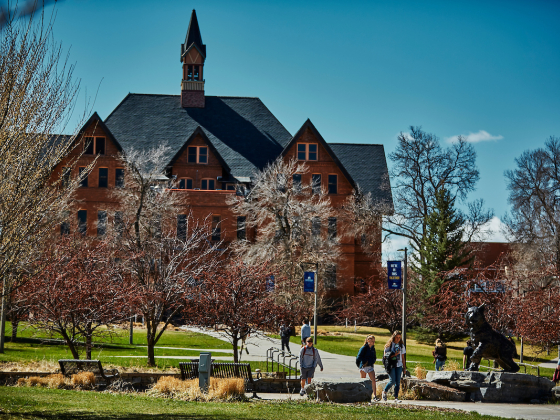
More than 150 faculty members and guests attended Montana State University’s Interdisciplinary Institute on Artificial Intelligence Faculty Symposium on March 26, an event designed to explore the possibilities and pitfalls of AI for higher education and research.

The event featured four panel discussions comprised of MSU faculty and others from around the Montana University System, tackling AI in research, teaching and learning, putting AI into action, and AI in higher education. The symposium was hosted by the MSU IIAI, which launched earlier this month after more than a year of planning. The institute is co-led by Doralyn Rossmann, dean of the MSU Library, and William Thomas, dean of MSU’s College of Letters and Science.
In opening remarks to the daylong symposium, MSU President Brock Tessman said AI will both challenge and enhance the university’s efforts in areas such as assessment, pedagogy and student success. MSU’s nationally recognized research, he added, will be tightly connected to the expansion of AI across society.
“We will be there to help solve problems and address opportunities that AI presents to Montana, the country and the world,” Tessman said.
Tessman told the crowd that the widespread use of AI will be different than past societal developments, technological or otherwise but that MSU is ready to help.
“Leaders in higher education over the years have addressed major challenges that we’ve perceived to be significant shifts in the way that we’ll teach, conduct research, the way that the public views higher education, and the role that higher education might play in workforce development and economic development,” he said. “I believe that this moment is different. Everyone is simultaneously inspired, uncertain, but ready for next steps. We can help lead folks through those next steps.”
Thomas, whose background is in the field of history, noted that everyone in attendance has likely given considerable thought to AI. “I’m excited about AI as a historian because it’s an accelerant to research and discovery,” he said.
Rossmann underscored the interdisciplinary nature of AI and the MSU Library’s role.
“We are a place that really relies on trust of information,” she said. “And so, we want to be in a space where we can help you figure out how to trust what’s in front of you. That means thinking critically, pausing before diving into those systems, and perhaps relying on open-source systems that don’t necessarily have a commercial driver behind them.”
During one of the question-and-answer sessions, audience member Kristen Intemann, professor of philosophy in MSU’s College of Letters and Science, asked panelists what makes AI trustworthy.
Trustworthy AI “requires effective integration of a human-verifying output” for accuracy, answered panelist Cody James, director of the Jameson Law Library at the University of Montana.
Panelist Jayne Morrow, CEO and director of the MSU Applied Quantum CORE, or QCORE, pointed to the importance of a middle ground.
“We can’t surrender the potential to do good with the growing uncertainty,” she said. “We have to find a way to meet in the middle with confidence.”
During a break, Intemann discussed the potential brought about by AI.
“We really are in a very transformative moment where these technologies with all of this potential are rapidly being adopted,” Intemann said. “But they also have lots of risks associated with them. And so, it’s really important for us to think critically about how we can integrate these technologies and interact with them in ways that benefit our students, our teaching, our research and our communities in Montana, and to make sure that we’re not doing harm.”
Intemann also serves as director of MSU’s Center for Science, Technology, Ethics and Society.
The MSU IIAI will host a national symposium Oct. 1-2 on the future of AI. The two-day event will be held in the forthcoming Gianforte Hall, and will bring together leading national speakers, faculty and students. More details on the fall symposium will be released at a later date.
Related Stories:
-
 Daines Champions Katie Lane for Federal Judgeship at Senate Hearing
-
 Jury Finds Musk Liable for Misleading Twitter Investors in 2022 Takeover Fight
-
 Zinke Delivers More Than $11.1 Million for Projects in Western Montana
-
 Gianforte Highlights Firearms Manufacturing Growth During Kalispell Visits
-
 Sheehy’s Bipartisan VA Home Loan Awareness Act Passes Senate
-
 Gianforte Highlights Value of Agricultural Exports During Visit to Dahlman Farms